
Building security is evolving as organisations look for more reliable ways to manage employee access, protect restricted areas and monitor movement within their facilities. Traditional RFID card readers and standalone HID access systems have played an important role in commercial security for decades. However, the growing adoption of biometric authentication is changing how businesses approach door access management.
Fingerprint recognition, facial recognition and integrated access control technologies are becoming increasingly important in offices, industrial facilities, healthcare institutions, warehouses and government buildings.
Rather than depending entirely on physical access cards, organisations are exploring systems that can verify a person’s identity through biometric credentials while maintaining compatibility with existing RFID and card-based infrastructure.
Why Traditional RFID and Standalone Access Systems Are Being Reconsidered
RFID access cards remain a popular choice because they are relatively simple to issue, replace and manage. HID is also a well-established name in secure identity and card-based access control technology.
However, conventional card-only systems have certain limitations. Access cards can be misplaced, shared or used by another person if additional identity verification is not implemented. Standalone readers may also provide limited centralised management and reporting capabilities depending on their configuration.
These challenges have encouraged businesses to consider biometric authentication and network-based access control systems.
Fingerprint and facial recognition technologies provide an additional method of verifying an individual’s identity, helping organisations improve access accountability and reduce dependence on physical credentials.
Fingerprint Recognition Is Becoming a Preferred Access Method
Fingerprint access control is widely used in commercial and industrial environments because it provides a convenient way to authenticate registered users.
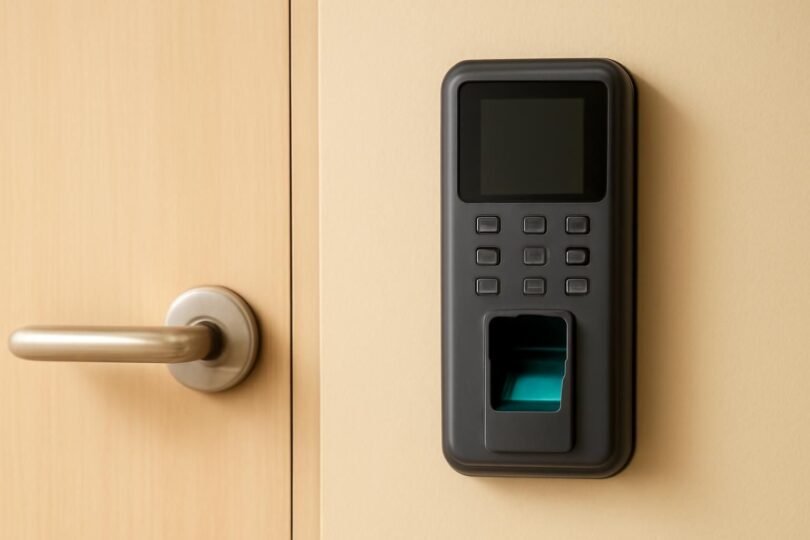
Modern fingerprint terminals can be connected to access controllers, electric locks and centralised management software. Depending on the device, they may also support RFID cards, PIN authentication and network communication.
Common applications include:
- Corporate offices and administrative buildings
- Server rooms and restricted departments
- Warehouses and logistics facilities
- Factories and manufacturing environments
- Educational and healthcare institutions
By combining fingerprint verification with appropriate access policies, businesses can establish more controlled entry procedures.
Facial Recognition and Contactless Door Entry
Facial recognition has introduced another approach to physical access management. Instead of presenting a card or touching a fingerprint sensor, authorised individuals can be verified through a facial recognition terminal.
Modern facial recognition devices can support rapid authentication, user databases and integration with access management platforms.
This technology is particularly useful in locations with frequent employee movement, high visitor volumes or a preference for contactless authentication.
Organisations can also combine facial recognition with RFID credentials or PIN verification where additional security is required.
HID and RFID Are Evolving Alongside Biometrics
The growth of biometric access control does not mean traditional RFID and HID technology is disappearing.
In many installations, organisations prefer a hybrid security architecture that combines established card credentials with biometric verification.
For example, RFID cards may be used for general building access, while fingerprint or facial recognition is required for sensitive areas. This arrangement allows businesses to strengthen security without necessarily replacing every existing reader and credential.
HID continues to be relevant in secure identity and credential ecosystems, while modern biometric manufacturers provide additional authentication options for different security requirements.
The objective is to create an integrated access control environment rather than rely on a single authentication method.
Leading Access Control Technologies and Manufacturers
The access control market includes several manufacturers offering solutions for different building sizes, security requirements and applications.
Suprema: Known for biometric fingerprint and facial recognition access control technologies, including networked readers and integrated security platforms.
ZKTeco: Offers fingerprint terminals, facial recognition devices, RFID readers and standalone or network-based access control solutions.
Dahua: Provides biometric terminals, card readers and integrated security technologies for commercial and institutional environments.
HID: A recognised provider of secure identity credentials, RFID technologies and access control solutions.
VIRDI: Specialises in biometric authentication technologies, including fingerprint and facial recognition systems.
Watchnet: Provides security and surveillance technologies, including video surveillance and integrated security solutions that can complement broader facility security infrastructure.
The appropriate manufacturer depends on the required authentication method, installation environment, software compatibility and long-term management requirements.
Why Integrated Access Control Is Important
A modern access control installation involves more than installing a fingerprint reader beside a door. Businesses must consider how readers, controllers, electric locks, exit buttons, door sensors and management software work together.
Network-based systems can provide centralised user administration, access permissions, event records and monitoring across multiple doors or locations.
For larger organisations, integration with CCTV and other security technologies can also help create a more comprehensive security environment.
A properly designed system should consider:
- Number of users and controlled doors
- Fingerprint, facial recognition and RFID requirements
- Controller and reader compatibility
- Centralised access management
- Integration with existing security infrastructure
- Future expansion and maintenance requirements
TACS Contracting and the Growing Demand for Biometric Security Solutions
As organisations modernise their physical security infrastructure, specialist security solution providers play an important role in identifying suitable technologies for different applications.
TACS Contracting is associated with the growing demand for modern security and access control solutions, including biometric authentication, RFID-based systems and integrated building security technologies.
With manufacturers such as Suprema, ZKTeco, Dahua, HID, VIRDI and Watchnet contributing to the wider security technology ecosystem, businesses have more options when planning new installations or upgrading existing infrastructure.
The focus is increasingly on selecting compatible technologies that support reliable identity verification, controlled entry and effective security management.
The Future of Commercial Door Access
The future of building security is likely to involve a combination of biometric authentication, RFID credentials, networked access controllers and integrated surveillance systems.
Traditional access cards will continue to serve organisations that value convenience and established credential infrastructure. However, fingerprint and facial recognition technologies are expanding the possibilities for stronger identity verification.
Rather than treating RFID, HID and biometric technologies as competing solutions, businesses can combine them to create flexible and scalable security environments.
As commercial buildings become more connected, integrated access control will remain an important part of protecting people, facilities and business assets.