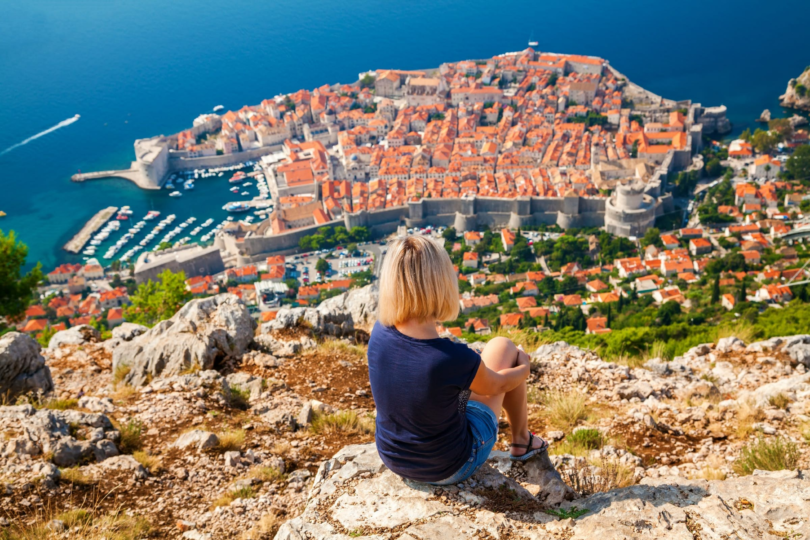

Croatia’s coast looks simple from a cruise ship deck. Stone towns. Blue water. Red rooftops. Spend a few days walking those streets with someone who knows the place, and a different country comes into view. One shaped by Greeks, Romans, Venetians, Ottomans, Habsburgs, and the small republic that out-traded all of them. Most travellers see only the postcard version. Private Croatia tours change that, because the story is the point.
Roman Bones Beneath the Streets
Stand in the centre of Split on one of our private Croatia tours, and you are inside a Roman palace. Diocletian, the emperor who retired here in 305 AD, built it as his seaside home. The walls still hold up apartments, cafes, and churches. People hang laundry from columns that are seventeen centuries old.
Pula, further north, has a Roman amphitheatre that once seated 20,000. It still hosts summer concerts. You can walk the underground passages where gladiators waited their turn. The arena is one of the six largest surviving Roman amphitheatres in the world.
These are not museum pieces behind glass. They are working parts of working towns. A good guide will show you which arches are original. Which ones did the Venetians rebuild? Which ones got patched after the wars of the 1990s?
The Venetian Centuries
For roughly 400 years, most of the Dalmatian coast belonged to Venice. You see it in the winged lions of Saint Mark carved above town gates in Trogir, Šibenik, Korčula, and Hvar.
Venice brought stone masons, shipbuilders, and a way of living turned toward the sea. The masons who built the cathedrals learned their trade in Venice, then settled in Croatia for the work. Builders finished Šibenik Cathedral in 1535 without using mortar. Stone slotted into stone. UNESCO lists it for that reason.
Walking these towns at sunset, when the cruise crowds have left, and the light goes gold on the limestone, is the moment most travellers remember years later.
Dubrovnik and the Republic of Ragusa
Dubrovnik calls itself a city. For five centuries, it was a country. The Republic of Ragusa kept its independence from 1358 until Napoleon arrived in 1808. It traded with the Ottomans, the Spanish, the English, and the African kingdoms.
The walls you walk today, almost two kilometres around, exist for one reason. Ragusa needed to protect that independence. The city abolished slavery in 1416, decades before most of Europe even debated the question. Earthquakes nearly levelled the city in 1667. The walls held.
The Lazaretto, one of the first quarantine stations in the world, still stands at the edge of the old harbour. A licensed local historian will walk you through the Rector’s Palace and the Sponza customs house. They explain how a city of a few thousand people built a merchant fleet that rivalled Venice.
Karst, Sea, and 1,200 Islands
The coast itself is a story written in stone. The Dinaric Alps drop straight into the Adriatic. Water has carved the limestone for millions of years. That is why Croatia has caves, hidden coves, and rivers that disappear underground for miles before surfacing again.
There are 1,244 islands and islets along the coast. Fewer than 50 of them have year-round residents. Each has its own dialect, its own foods, and its own quiet rivalries with the next island over.
The water itself is famous for its clarity. UN environmental surveys have placed the Adriatic among the cleanest seas in Europe. You can see the bottom at twenty meters in some bays. Inland, Plitvice and Krka show the freshwater side of the same karst geology. Travertine dams, turquoise pools, waterfalls that change colour through the year.
Food That Tells You Where You Are
Dalmatian cuisine is what people ate before refrigeration changed things. Olive oil pressed in November. Pršut, the air-cured ham of Drniš, hung in lofts open to the bura wind. Pag cheese, sharp and salty because the sheep graze on herbs salted by sea spray.
A driver who grew up here will skip the tourist tavernas and take you to a konoba where the owner’s grandmother runs the kitchen. That is the meal you remember.
Why Private Croatia Tours Change the Trip
Bus tours move you. They do not show you. Group tours run on a clock. Yours. By the time you queue for a photo at the city walls, the cruise crowd has filled every cafe in the old town. The real stories never reach you.
A private Croatia tour with a named driver and a hand-picked guide gives you access to the country a passing visitor never sees. You eat where locals eat. You arrive at the walls before the ship’s dock. You hear the family history of the village you are passing through.
Croatia rewards travellers who slow down. The coastline has been there for two thousand years. There is no rush, and there is no good reason to see it through a bus window.
Tell us your travel ideas. Your private Croatia tour will follow the coast you actually want to see.