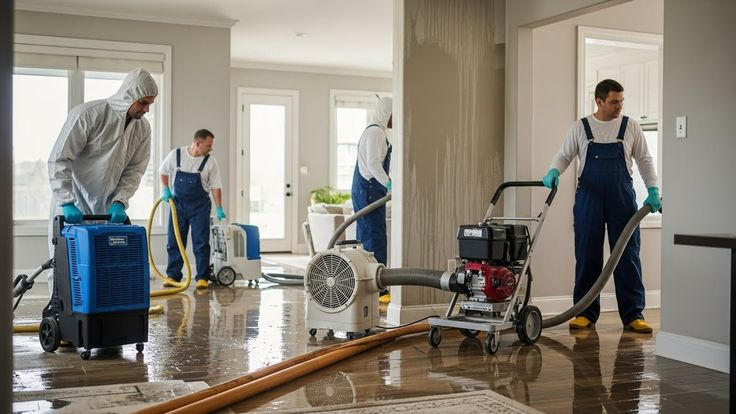
Floods are one of the worst calamities that a property owner could face. Floods come in various types depending on what caused them, and these include flooding due to rain, floods from overflowing rivers, broken pipes, or plumbing problems. Floods are fast and may wipe out the whole house/building within no time.
This is why many homeowners depend on seasoned firms such as Restoration Logistics Boulder for prompt and safe restoration of their properties. It can be quite useful to know the most typical issues resulting from flooding as well as how to deal with them in flood damage restoration.
Image Source: Pinterest
Rapidly Spreading Standing Water
One of the first issues seen by homeowners when there is a flood is standing water. Just a few inches of water can saturate carpeting, hardwood flooring, drywall, furniture, and other possessions in minutes. The water will continue to spread if not controlled and may affect the very foundation of the property.
How Restoration Professionals Handle This?
The first thing that professional restoration teams do is that they drain the standing water by making use of pumps and large-scale industrial extraction tools. These tools drain the water out quickly unlike household tools such as vacuum cleaners. The next step for experts is that they also check nearby areas to make sure whether the water has spread to other places or not.
Moisture Hidden Behind Drywalls and Under Floors
One of the most significant complications after a flood is the existence of moisture which is unseen. Moisture usually tends to get trapped inside walls, under floors, within insulation materials and within wooden structures. There are times when surfaces look dry but still have moisture in their interiors.
How Restoration Professionals Handle This?
Experts use moisture detectors, infrared cameras and thermal imaging systems to find the moisture present inside the building materials. Once the locations of such areas have been determined then air movers and dehumidifiers are used to drain the moisture thoroughly.
Mold Growth and Bad Indoor Air Quality
One of the effects that floods can cause is mold. When there is moisture, it creates perfect conditions for the development of mold spores within 24 to 48 hours. The mold will spread throughout walls, ceilings, floors, and HVAC systems if moisture is not cleaned up.
How Restoration Professionals Handle This?
To start with, the source of moisture should be eliminated first before dealing with the problem of the mold. Experts dealing with restoration use antimicrobial treatments, cleaning agents, and filters in the air to eliminate mold. When mold gets into the materials, then those materials should be replaced.
Damaged Drywall and Insulation
During flooding, both drywall and insulation will absorb water immediately. As a result, drywall will become soft and unstable, and insulation will lose its capability of temperature control. Mold will start growing on drywall and insulation if they are not replaced.
How Restoration Professionals Handle This?
The walls are examined using moisture detectors to find out the amount of moisture absorbed. The areas with damaged drywall will then have to be removed to get rid of the moisture, and wet insulation will also need to be removed and replaced. This will ensure that the wall cavity is free from moisture and intact.
Flooring Damage and Warping
Various types of flooring materials respond differently to flooding in terms of warping, swelling or expansion. Hardwood flooring might expand, cup and warp, laminate flooring usually swells irreversibly, carpet will absorb huge amounts of moisture and tiles might become loose due to moisture seeping under the glue holding them together.
How Restoration Professionals Handle This?
Each flooring material should be separately checked to see if it is salvageable or needs to be replaced. In some cases, hardwood flooring can be salvaged by employing drying systems for moisture extraction. In cases where the materials are too badly affected with moisture, they will have to be removed.
Hazardous Electrical System
Combination of water and electricity can pose high risks of danger. Water can damage outlet boxes, wiring, switches, appliances, and electrical systems of homes. Once the floodwater subsides, there is a possibility that there can be hidden hazards like fire or electrocution because of faulty electrical systems.
How Restoration Professionals Handle This?
The most crucial thing is safety. Before entering the flooded zone, restoration professionals make sure that the power is cut off. The job will be done by qualified electricians who will inspect the electrical system, change wires and sockets to meet the existing regulations.
Contaminated Floodwater and Sanitary Problems
The floods that arise due to sewage backing up, drainage flooding, and disasters are always full of germs and contaminants like chemicals and viruses. Being exposed to such floodwater is very risky to your health. Furthermore, the water can soak through carpets, furniture, and drywalls; therefore, there is need for sanitation.
How Restoration Professionals Handle This?
Firstly, the contaminated water is cleaned up; secondly, the area is washed and sterilized with the help of the best antimicrobial agents. Those things that cannot be cleaned properly are disposed of according to the standards of the industry. Cleaning is one of the crucial steps of professional flood damage restoration.
Damage to the Building Structure
Floodwater not only destroys the surface of the floors but can affect the building structure itself. The building’s wooden frame, subflooring, beams, foundation, ceilings, and staircase structures may all be affected by the exposure to the water. This type of damage must be identified in order to prevent costly consequences in the future.
How Restoration Professionals Handle This?
Professionals conduct a detailed analysis of the structure’s integrity before carrying out any renovations. Damaged frames, weak flooring, and faulty construction material are fixed or substituted as necessary. Restoration professionals also make sure that all wet parts are completely dried before renovation commences. Early detection of structural damages restores safety and integrity of the property.
Conclusion
Flooding effects tend to go beyond what initially meets the eye. Where there is the problem of standing water, other aspects like increased moisture levels, growth of mold, destruction of dry walling, problems with floors, electrical hazards, contamination, and damage to building structures may remain unnoticed even several days after the flooding event.