
You cannot teach someone to spot a forgery by describing one. They have to see it, hold it, compare it against the real thing and notice the small detail that does not fit. That is the awkward paradox of fraud awareness training: to teach people how to catch a fake receipt, you need convincing fake receipts to train against. Generating them on purpose, in a controlled and clearly labelled way, is how finance teams, auditors and trainers build a genuinely sharp eye.
Why realism is the whole point in training
A lot of training material uses obviously fake examples, the cartoon receipt with round numbers and a clip art logo. It teaches nothing, because no real attempt at deception looks like that. The receipts that actually slip through an approval process are the ones that look right at a glance, and the only way to train people to catch those is to show them examples at the same level of realism.
This is where a tool built from real scans is useful in a way a crude mockup never could be. You can produce a receipt that looks entirely legitimate, then plant a single tell in it, the kind of subtle inconsistency a real reviewer has to learn to notice, and ask your trainees to find it. That is active training, not a lecture.
The tells worth teaching
A good training set is built around the specific signals that expose a manipulated receipt. The classics include arithmetic that does not reconcile, where the subtotal, tax and total do not add up. There is the impossible timestamp, a purchase logged outside the store’s opening hours. There is the implausible detail, a store number that is not in the chain’s format, a price that does not match the date, an item that does not belong in that kind of shop. There is the formatting mismatch, a coffee receipt missing its rewards line or a gas receipt with no pump number. And there is the duplicated or altered total, where a figure has clearly been changed without the rest of the document following.
By generating receipts that contain exactly these flaws, deliberately and one at a time, you can build a progression from easy to subtle and measure how your team’s eye improves.
Building the training set
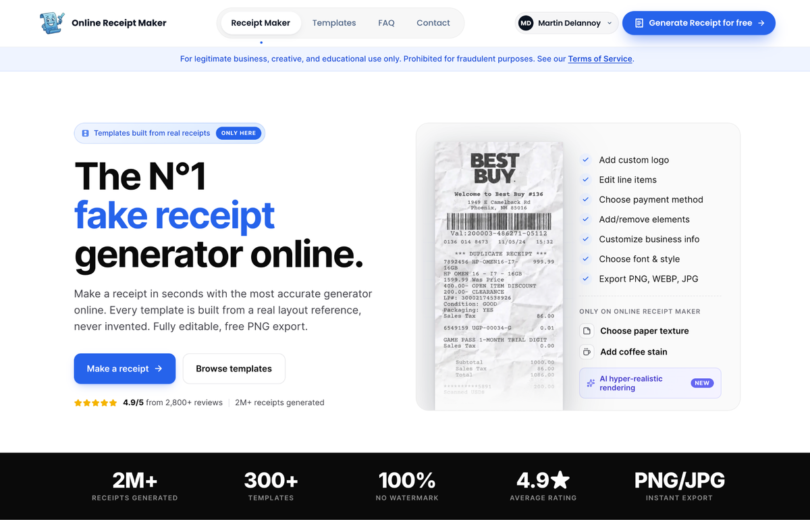
For constructing controlled examples, Online Receipt Maker works well because every field is editable and the templates are brand accurate. You can produce a batch of legitimate looking receipts, then create altered twins of each with a single planted inconsistency, giving you matched pairs that make the lesson concrete. The realism extras let you vary the quality too, so trainees learn to read a faded or creased receipt rather than only a pristine one.
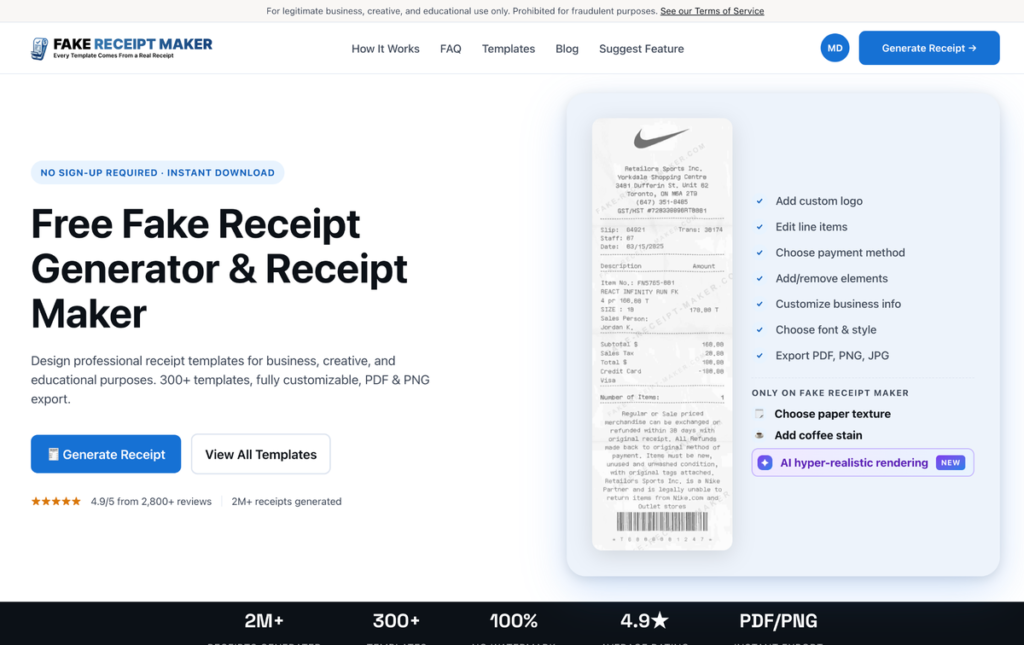
When you need volume for a large cohort, Fake Receipt Maker generates a varied set quickly through its three step flow, with PDF export that is convenient for assembling a printed workbook or a digital module. Either way, every example is invented, so no real financial data ever enters the training material.
Designing an effective exercise
A workshop that lands tends to follow a simple arc. Start with a clean, fully legitimate receipt and walk through its anatomy so everyone knows what right looks like. Then present a stack that mixes genuine looking receipts with planted fakes, and have small groups flag the suspicious ones and explain why. Reveal the answers, discuss the tells that were missed, then run a second round at a higher difficulty. The matched pair structure, a real receipt next to its altered twin, is especially effective because it isolates the single thing that changed.
Measuring whether the training worked
A training session is only useful if it changes behaviour, so build in a way to measure it. A simple before and after works well: at the start, give trainees a mixed stack and record how many fakes they catch and how long it takes. Run the workshop, then at the end give them a fresh stack at similar difficulty and measure again. The improvement in both accuracy and speed is your evidence the training landed, and the specific tells people still miss tell you what to reinforce next time. Because you generated every example, you control the difficulty precisely across both rounds, which makes the comparison fair in a way a random pile of real receipts never could.
Why generated beats real here
Beyond the obvious privacy benefit, generated receipts give you something real ones cannot: control over the lesson. You decide which tell each example demonstrates, you can make the difficulty progress, and you can produce as many matched examples as your cohort needs. A pile of real receipts gives you whatever happened to be in someone’s wallet, with no planted lessons and a stack of real personal data you now have to handle carefully.
Keep it legitimate
This is one of the clearest legitimate uses there is, since the entire goal is to help people prevent fraud. Both tools are built for exactly this kind of educational and professional work and state on their own pages that using a generated receipt to actually deceive anyone is prohibited. Training material that teaches detection sits firmly on the right side of that line, with the bonus that it contains no real data at all.
Bottom line
The best fraud awareness training puts realistic examples in front of people and asks them to find what is wrong. A fake receipt generator lets you build that material on purpose, with planted tells, matched pairs and a difficulty curve, all without a scrap of real financial data. Construct the examples deliberately, run the exercise as active practice rather than a lecture, and your team will leave able to catch the kind of fake that would otherwise sail through.