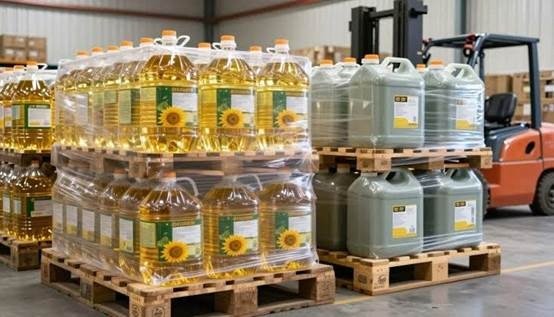
The lowest price per ton can become the most expensive purchase once quality variation, documentation gaps, unsuitable packaging, freight surprises, and rejected deliveries are included.
By Inter Oliya Editorial Team
Bulk sunflower oil looks simple on a quotation: product type, quantity, packaging, delivery term, and price. Yet food manufacturers, distributors, restaurant groups, wholesalers, and private-label brands are not buying a generic liquid. They are buying an ingredient, a logistics project, a compliance file, and a supply commitment at the same time.
That is why the cheapest offer can create the highest total cost. A small difference in specification may affect frying performance or finished-product consistency. A weak traceability file may delay customer approval. A poorly selected packaging format may increase handling losses. An unclear delivery term may shift customs, insurance, unloading, or inland-transport costs to the buyer unexpectedly.
Strong procurement therefore starts before the price negotiation. It begins with a written definition of what the business needs, how the oil will be used, what evidence must accompany each shipment, and what will happen if the delivered product falls outside the agreed requirements.
The following nine checks give commercial buyers a practical framework for reducing risk before approving a bulk sunflower oil supplier.
1. Start With the Application, Not the Product Name
“Sunflower oil” is not a complete purchasing specification. The correct choice depends on the intended use.
A refinery may require crude sunflower oil as an input for further processing. A snack manufacturer may need refined oil with consistent sensory and performance characteristics. A high-temperature frying operation may evaluate high-oleic sunflower oil because the fatty-acid profile differs from conventional sunflower oil. A supermarket brand may need refined oil in retail-ready bottles with market-specific labels and cartons.
The Codex Standard for Named Vegetable Oils treats conventional sunflowerseed oil and high-oleic sunflowerseed oil as distinct product categories. That distinction matters because buyers should not assume that two products with similar names will perform identically in production.
Before requesting quotations, define:
• The intended food or processing application
• Refined, crude, high-oleic, or another required format
• Expected operating temperature and use conditions
• Required sensory characteristics
• Whether the oil will be used as an ingredient, processing aid, frying medium, or retail product
• Packaging, handling, and storage constraints at the receiving site
When the application is clear, the buyer can compare suitable offers rather than comparing prices for products that are not commercially equivalent.
2. Convert the Purchase Request Into a Written Specification
A reliable transaction needs more than a product description in an email. The buyer should issue a written specification and require the supplier to confirm it before the order is accepted.
The specification should identify the product, permitted tolerances, analytical requirements, packaging, labelling, shelf-life expectations, documentation, and acceptance procedure. Depending on the product and market, the commercial specification may address parameters such as free fatty acids, peroxide value, moisture and volatile matter, colour, fatty-acid profile, contaminants, additives, and any buyer-specific requirements.
The objective is not to create the longest possible document. It is to remove ambiguity.
The specification should also state:
• Which test method or standard applies
• Whether results must appear on a certificate of analysis
• Who may perform testing
• How samples will be retained
• What constitutes a non-conforming shipment
• Whether replacement, reprocessing, discount, or rejection applies
A price is meaningful only when it is attached to a clearly defined product.
3. Verify the Supplier and the Real Supply Chain
A professional website is not enough evidence for a high-value food ingredient purchase. Buyers should verify the legal entity, business address, registration details, tax information where applicable, banking instructions, and the people authorised to negotiate and sign.
The next question is equally important: who actually produces, stores, packs, and loads the oil?
Some suppliers manufacture directly. Others coordinate supply through processing plants, refineries, storage terminals, bottlers, or logistics partners. Either model can work, but the buyer needs visibility into the chain of responsibility.
Ask for a clear explanation of:
• The production or refining location
• The storage location
• The party issuing the certificate of analysis
• The party named on export and transport documents
• The party responsible for packaging and loading
• The process for handling quality claims
Bank-account changes, last-minute beneficiary changes, unexplained third parties, or inconsistent company names across documents should trigger additional verification before funds are released.
4. Review Evidence Before Approving Commercial Volume
Supplier claims should be translated into documents and, when appropriate, independent checks.
Request a representative product specification, a recent certificate of analysis, relevant food-safety or quality certificates, sample labels for packaged products, and examples of the commercial documents expected with shipment. Certificates should be checked for scope, validity, issuing body, site name, and whether they apply to the product or operation being purchased.
A sample can help with sensory or application testing, but a sample alone does not prove that a full commercial shipment will match. The purchase contract should connect batch release to agreed analytical and documentary requirements.
For higher-risk or first-time transactions, buyers may also consider:
• Pre-shipment sampling
• Independent laboratory testing
• Inspection at loading
• Seal-number verification
• Weight or quantity checks
• Photographic loading evidence
• Retained reference samples
The right level of verification depends on order value, product use, destination requirements, and the buyer’s risk tolerance.
5. Test Traceability and Recall Readiness
Traceability should be tested as an operational capability, not accepted as a general promise.
Under EU food law, food business operators must be able to identify who supplied them and the businesses to which their products were supplied. For a bulk edible-oil buyer, this means records must connect the supplier, product, batch, production or packing details, shipment, receiving records, and onward use or distribution.
Before the first order, ask the supplier to demonstrate how a shipment can be traced. A useful traceability file may include:
• Batch or lot code
• Production or packing date
• Certificate of analysis
• Tank, container, seal, or vehicle identification
• Quantity and packaging details
• Dispatch and delivery records
• Customer and destination references
The buyer should also define how a recall or withdrawal would be communicated. Who is contacted first? How quickly can affected batches be identified? Which records are available outside normal office hours? A supplier that can answer these questions clearly is easier to manage when a real incident occurs.
6. Match Packaging and Transport to the Operation
Packaging is not a minor detail. It affects product protection, unloading, storage, labour, waste, and total landed cost.
Retail-ready bottles may suit supermarkets and distribution brands. Drums or intermediate bulk containers may suit food manufacturers with moderate consumption and limited tank infrastructure. Flexitanks and road tankers may improve economics at higher volumes, but they require appropriate receiving facilities, handling procedures, and transport controls.
The buyer should confirm:
• Food-contact suitability of packaging and transfer equipment
• Packaging size, material, closure, and tamper evidence
• Pallet pattern and load stability for packaged products
• Tank or container cleanliness
• Seal controls
• Previous-cargo and cleaning documentation where relevant
• Unloading connection, pumping, and hose requirements
• Temperature and storage conditions
• Responsibility for damaged or leaking units
The receiving site must be able to accept the chosen format safely. A low unit price loses its value if the buyer must arrange emergency repacking, additional labour, or unsuitable temporary storage.
7. Compare Landed Cost Under a Named Delivery Term
A quotation should be converted into cost per usable kilogram, litre, drum, or retail unit at the buyer’s facility.
That calculation may include the product price, packaging, inland transport, terminal charges, ocean freight, insurance, customs services, import duties, taxes, inspection, documentation, demurrage risk, unloading, storage, finance cost, and expected loss or waste.
The delivery term must be stated precisely, including the named place or port and the applicable Incoterms edition. ICC’s Incoterms rules allocate specific costs, risks, and obligations between buyer and seller, but they do not replace the complete sales contract.
For example, FOB and CIF are designed for sea or inland-waterway transport, while DAP can be used across transport modes. Buyers should not choose a term merely because it appears familiar. The selected term must fit the transport route, insurance strategy, customs capability, and point at which the business is prepared to assume risk.
Compare suppliers using the same assumptions. Otherwise, one offer may look cheaper simply because it excludes work and cost included in another.
8. Protect Quality During Storage and Use
Commercial quality can deteriorate after delivery if storage is poorly controlled.
Sunflower oil should be protected from conditions that accelerate oxidation or introduce contamination. The buyer’s storage plan should address light, heat, air exposure, moisture, foreign odours, incompatible materials, tank cleanliness, stock rotation, and the time between opening and use.
Receiving procedures should include:
• Checking seals and packaging condition
• Confirming batch and quantity
• Recording the delivery date
• Reviewing the certificate of analysis
• Inspecting for leakage, damage, or abnormal appearance
• Segregating the load until release when required
• Retaining samples according to company policy
For private-label or bottled products, the buyer should also verify label accuracy, coding, carton strength, pallet stability, and the remaining commercial shelf life on arrival. Shelf life should be evaluated against the real selling window, not only the date printed on the pack.
9. Use a Controlled Trial Order and Supplier Scorecard
The first shipment should be treated as a qualification exercise.
A trial order allows the buyer to test communication, documentation, product conformity, loading, transit, receiving, application performance, and claim handling before committing to larger or recurring volumes. The trial should be commercially meaningful but small enough to limit exposure.
Define success before the order is placed. A supplier scorecard can track:
• Specification compliance
• Document accuracy
• On-time and in-full delivery
• Packaging condition
• Application performance
• Response time
• Claim resolution
• Final landed cost
• Internal user or customer feedback
Buyers evaluating commercial formats, packaging, and export support can review *Inter Oliya’s bulk sunflower oil supply options** when building a structured request for quotation.
A supplier should earn larger allocations through consistent performance. This is more reliable than approving annual volume based on one attractive price or one successful sample.
Conclusion
Bulk sunflower oil procurement is not only a sourcing decision. It is a coordinated quality, compliance, logistics, finance, and continuity decision.
The strongest buyers reduce risk by defining the application, issuing a written specification, verifying the supply chain, reviewing evidence, testing traceability, matching packaging to infrastructure, calculating landed cost, protecting the product after delivery, and qualifying suppliers through controlled orders.
This process may require more work before the first purchase, but it creates faster comparisons, clearer negotiations, fewer surprises, and better long-term supplier relationships. In a market where the cost of failure can include production downtime, rejected stock, customer claims, or damaged brand trust, disciplined buying is not bureaucracy. It is commercial protection.
Proposed Author Biography
Inter Oliya Editorial Team publishes practical guidance on sunflower oil procurement, quality control, private-label planning, packaging, and export logistics. Inter Oliya is a Ukraine-based supplier supporting commercial buyers with refined, crude, bulk, bottled, and private-label sunflower oil options for European and international markets.