Zero Trust is one of those terms that has zoomed from specialist terminology to mainstream conversation almost overnight. Executives mention it at strategic planning meetings, regulators discuss it in compliance frameworks, and security teams argue over how best to implement it. Yet, the phrase is widely abused; it gets mixed up with a product category or simply becomes treated as a configuration instead of an architectural philosophy.
Zero Trust is basically a way of thinking about who and what personal resources should be allowed to access. It challenges one assumption that shaped network security for decades: that connections originating inside a defined boundary could be treated as trusted by default. The cardinal rule of Zero Trust is that no connection, at any time from anywhere, is trusted by default. Trust is only a valid concept at the moment of each access request, not something granted or revisited once and then forgotten later in the session.
What kind of technical and operational commitments does this philosophy lead to? The most straightforward way to make sense of what Zero Trust is really about in practice and why those commitments follow logically from the main premise.
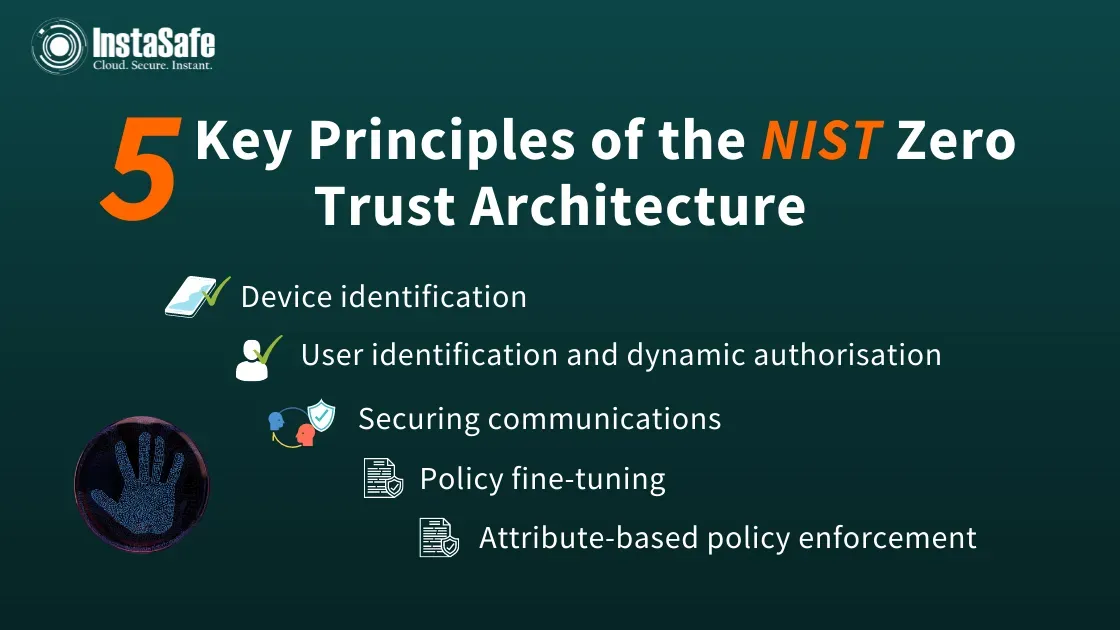
In this article, we provide zero trust and core principles that discuss the key components of the framework as well as why each element is needed for a functioning zero-trust architecture.
Core Claim: Implicit Trust Is a Vulnerability
Network security has traditionally worked on an inside/outside distinction. Traffic passing over the inbound perimeter was screened thoroughly. As such, traffic that was already internal to the network was afforded an order-of-magnitude higher level of trust. Thus where you were, created a tier of connections trusted not for being verified, but merely because of who they happened to be with.
This made an assumption that attackers relentlessly discovered and tested. Armed with credentials, they could simply move around inside the network as if they were legitimate users, be it via phishing or supply chain compromise, or unpatched vulnerabilities. The trust meant to show that a connection was secure instead served as an open door to our security controls.
Zero Trust removes this vulnerability by eliminating the class of implicitly trusted communications. No longer is the question if a connection comes from inside or outside. This begs the question: “has this requester been authenticated, is their device allowed, are they requesting a resource they have authorization to reach and more importantly behaving as the identity would be expected at that point in time?”
A Building Block of Continuous Verification
Continuous verification is not just a more frequent version of the authentication check (i.e. at login). It signifies a structural shift in access decisions within a session.
In traditional architecture, an authenticated user sits on a session that lasts until it expires. The User can do whatever the session permits for as long as the User has it, without further evaluation. A Zero Trust architecture continuously evaluates the conditions that justified initial access. Abnormal behavior in the device posture, as well as any access to resources outside of the expected scope or connection from an unexpected geographic location, can also initiate a re-evaluation, restriction or termination of access.
The concept of a foundational security principle helps clarify what this means in practice. A principle, defined as a comprehensive and fundamental law or doctrine that underpins other conclusions, is different from a policy or a rule. Zero Trust functions at that foundational level. Continuous verification is not a feature that can be switched off without abandoning Zero Trust; it is definitionally part of what the model means.
Identity as the Organizing Element
If Zero Trust eliminates the network perimeter as the organizing principle in security, we surely need a new one to replace that lost paradigm. Within Zero Trust that something is identity. Through this verified identity, which is tied to every access decision, the context that can be applied against the request is known.
Identity is no longer limited to a human user in this case. You should get the same treatment known to individual employees: service accounts, automated processes, API tokens and device identities. Instead, if any of these identities is compromised or wrongfully used, it is the behavioral and contextual evaluation layers within the Zero Trust that will expose that an identity represents a problem and not a valid credential, automatically resulting in legitimate access.
This shift fundamentally changes the role identity management plays in security, making it a foundational technology rather than simply an enabling one. To adopt Zero Trust well, an organization needs to have confidence that they know exactly what identities exist in their environment, that permissions are scoped appropriately for each identity, and that all systems evaluating requests for access have sufficient context necessary to recognize the difference between normal behavior and anomalous behavior for each one.
Define With the Least Privilege
The connection between Zero Trust and least-privilege access is so tight that one can barely be achieved without the other. The principle of least privilege states that any identity (human or automated) should be given only the access necessary to perform a specific task, and no more.
This constraint is not just a general risk-reduction. It limits the blast radius of any type of breach. If an attacker compromises an identity that has broad permissions, they gain those permissions. More tightly scoped permissions on an identity constrain the value of any single compromised identity for an attacker. So least privilege is not just an opt-in hardening measure you add on top of Zero Trust, it is baked into what Zero Trust means.
Explicit Policies Over Implicit Trust
One of the main features of Zero Trust implementations is that they go from implicit to explicit policies. A classic model is that most of the access you do in an environment is granted, because nothing forbids it specifically. It assumes that any set of internal devices can talk, layering on prohibitions against that permissive state as a system of security.
Zero Trust inverts this. By default, access is denied and explicit policies dictate permission. This necessitates that organizations discover what resources are there, which identities require access and, if so, under which conditions. Writing those policies requires a level of clarity about the environment that is often revelatory to organizations: systems that were presumed to communicate for legitimate reasons frequently lack any real rationale documented as to why they are connected.
How does this all tie back to zero trust?
Zero Trust architecture does not live in a vacuum. The success depends upon the quality of data input into the policy evaluation process to transit. Threat intelligence, vulnerability data, behavioral baselines and device posture signals help determine whether to allow or flag an access request.
That’s why the credential-based threat analysis is related to Zero Trust implementation. Summaries of analyses by security researchers reporting on credential leaks highlight how credentials are stolen in the context of breaches and then traded and hoarded to provide permanent availability for use long after any incident. This is exactly where the verification and behavioral monitoring layers of Zero Trust come into play. The credential is flagged even if it seems legitimately signed, as the value of aggregated legitimate usage in that manner is much higher than its pure technical possibility.
What Zero Trust Is Not
- Zero Trust is not a product: No one entity, no matter how it is sold, is a Zero Trust architecture. It is a model that is enforced through a mix of technical controls, organizational policies and operational practices.
- Zero Trust is not a destination: Organizations never reach it. The environment evolves, the threats change and finally, the units of verification that fuel the model should change as well. Zero Trust is more accurately portrayed as a continuous operating model rather than a project with an end goal.
- Zero Trust is NOT the same as eliminating all trust: The framework recognizes that trust must exist, but it should be earned and situationally specific as well as continuously reassessed rather than allocated by network position and locked in place.
Frequently Asked Questions
How can Zero Trust be summarized in the simplest way possible?
By default, Zero Trust means that no connection is a trusted one, whether its origin be internal or external. All access requests should be validated against policies based on identity, device health and context (continuous verification versus one-time validation).
What are the basic principles of Zero Trust?
The basic principles are: verify explicitly by always assessing Identity, Device and Context for every access request; apply least-privilege access to limit permissions to what an identity actually needs; assume breach in order to constantly monitor behavior and minimize the ability of any compromised element from impacting the entire environment.
How Zero Trust Differs From Perimeter Security
Traditional perimeter security assumes that anything inside the border of your network is trusted. Any connection, before it is validated, is considered potentially hostile with zero trust and this principle extends to origin; all access requests are continuously evaluated as opposed to providing a persistent session after an initial authentication event.