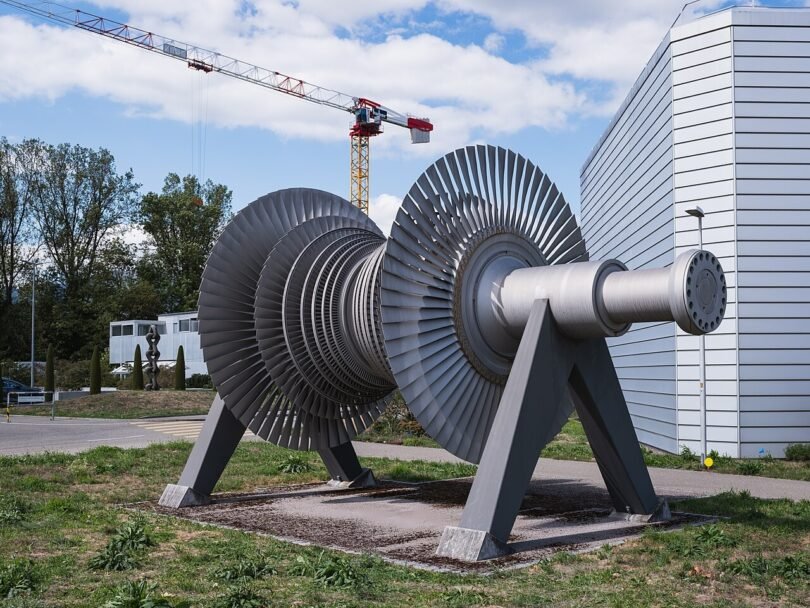

Every advanced reactor design eventually stops being a physics problem and becomes a materials problem. That is the stage molten salt reactors have reached, and it is why the new research programme launched by Dutch developer Thorizon with TNO, the Netherlands Organisation for Applied Scientific Research, matters beyond its modest scale: the partners will systematically test how candidate materials withstand molten salt corrosion, generating the evidence base for Thorizon’s PIONEER demonstrator reactor.
Molten salt reactors are an old idea with new momentum. Conceived in the 1960s and then shelved, the design circulates liquid fuel dissolved in hot fluoride or chloride salts rather than burning solid fuel rods. The physics offers elegant safety arguments — low operating pressure, strong negative feedback, passive cooling pathways — but the chemistry is unforgiving: the same hot salt that makes the reactor work spends its life trying to dissolve the reactor itself.
Corrosion: The Problem That Decides the Design
In a molten salt system, corrosion is not surface rust; it is selective chemical attack. Hot salts can leach chromium and other elements from alloys, embrittling pipes and vessels from within, while temperature gradients drive mass transfer that deposits material in colder sections. Impurities in the salt — moisture, oxides, fission products — accelerate everything. A reactor licensed for decades of operation needs alloys, coatings and salt-chemistry controls whose behaviour is not theorised but measured, over long exposures, at real temperatures.
That is precisely the work Thorizon and TNO have set up: exposing material samples to molten salt conditions and characterising what the salt does to them. TNO brings decades of high-temperature materials and energy-transition research; its capabilities are described across TNO’s research programmes. Thorizon, a spin-off from the Dutch nuclear research ecosystem, brings the reactor design the data will serve — including the PIONEER demonstrator intended to prove the concept at meaningful scale, with details published by Thorizon.
Why Demonstrators Need Data Before Concrete
The sequencing here is the story. Nuclear history is full of designs that were buildable on paper and unlicensable in practice because the materials evidence lagged the engineering ambition. Regulators do not license simulations of corrosion; they license test data, degradation models validated against that data, and inspection regimes that can detect damage before it matters. A materials programme launched before the demonstrator’s final design freeze is how a developer buys regulatory credibility early, when it is cheap.
There is a commercial logic too. Thorizon’s concept emphasises using existing nuclear waste streams as part of its long-term fuel story, a proposition whose value depends entirely on the reactor actually working for long periods between interventions. Every additional year a vessel or heat exchanger provably survives is worth real money in that model.
Europe’s Advanced Reactor Race
Thorizon is one of a cluster of European ventures — alongside French, Danish and Swedish efforts — trying to turn advanced fission into a continental industry rather than an imported product. The competition is as much about supply chains and test infrastructure as reactor physics: whoever builds the corrosion loops, the hot cells and the qualified alloy suppliers first builds the moat everyone else must cross. National research organisations like TNO are the quiet enablers of that race.
What Success Would Look Like
The programme’s outputs will not be dramatic photographs; they will be curves — weight change against exposure hours, crack growth against temperature, chemistry limits inside which candidate alloys behave. From those curves come the design decisions that determine whether PIONEER is a landmark or a lesson: which alloys for which components, what salt purification the plant needs, what inspection intervals the safety case assumes.
The Unglamorous Work That Decides Revolutions
Data Rooms Decide Investment Rounds
There is a financial translation of all this testing that founders understand instinctively. Advanced reactor companies raise money against milestones, and the milestones that sophisticated energy investors respect are not renderings or letters of intent — they are operating hours and materials data: loops that ran, samples that survived, degradation rates that came in inside the model’s envelope. A corrosion programme with a national institute’s name on it produces exactly that class of evidence, legible in due-diligence rooms in a way that design studies are not.
The programme also builds the less visible asset of people. Corrosion science for molten salts is a small global guild, thinned by the decades when the technology slept. Every test campaign trains the technicians and researchers the industry will need at ten times the scale, in the country that hosts the work. Skills pipelines of that kind compound quietly and then suddenly look like strategy.
Whether PIONEER ultimately succeeds will depend on economics and politics far beyond any laboratory. But its technical fate is being decided now, in exposure rigs and analysis suites, by the oldest method in engineering: put the material in the environment, wait, and measure what the environment did. Thorizon and TNO have started the waiting properly — with instruments attached.
The programme’s design also reflects a lesson the wider industry has learned expensively: corrosion behaviour cannot be extrapolated safely from short tests. Degradation mechanisms switch on at thresholds — of temperature, of impurity concentration, of exposure time — that brief experiments never reach. Long-duration loops running representative chemistry are slow and unglamorous, and they are the only instruments that can see those thresholds coming. Building them now, years before PIONEER must commit to its materials, is the schedule decision on which the whole demonstrator quietly depends.
Energy transitions are usually narrated through breakthroughs, but nuclear history teaches a different lesson: revolutions are decided by the unglamorous disciplines — welding, chemistry, corrosion science — executed patiently and documented relentlessly. Thorizon and TNO have started exactly that work. If molten salt reactors are to have their second act, it will be written in test data like this.