
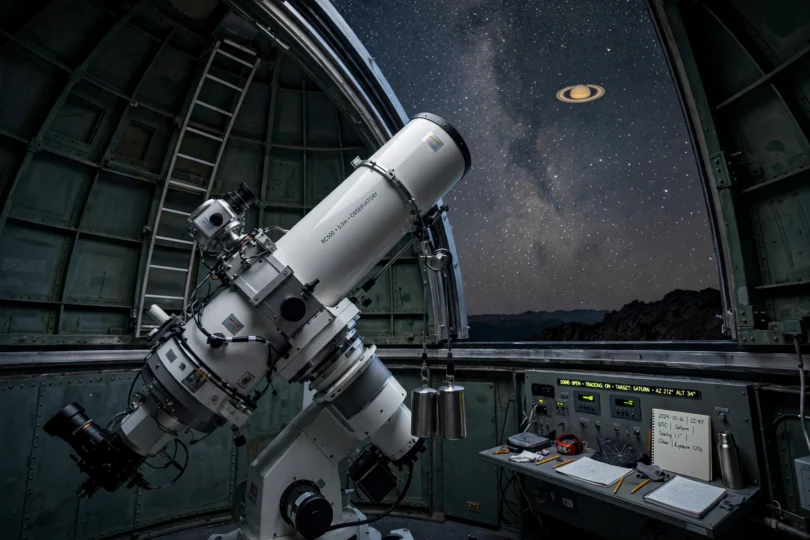

Every market has a runaway leader, and in the solar system’s moon rankings Saturn has just made its position unassailable. Astronomers have confirmed 128 new moons, lifting Saturn’s total to 274 — more than the other planets combined, and a dramatic jump from the already record-setting 146 recognised before.
Business readers may wonder why a moon census deserves attention beyond the science pages. The answer is that discoveries like this are returns on long-term investment: in telescope time, in skilled researchers, and in data archives maintained for years before they yield their biggest result. The Saturn survey is a lesson in how patient capital — of the scientific kind — compounds.
The investment behind the result
The new moons emerged from a multi-year survey using the Canada-France-Hawaii Telescope on Mauna Kea, with a team that included Dr Edward Ashton of the University of British Columbia. There was no single eureka observation. The group accumulated deep images over several years, then applied a “shift and stack” process: aligning exposures to Saturn’s motion and combining them so that ultra-faint moons accumulate into detections.
Only after follow-up observations fixed each object’s orbit did the International Astronomical Union formally recognise the moons. It is a pipeline with quality control at every stage — closer to an audit than to a lucky snapshot. The observatory’s background and instrumentation are documented by the Canada-France-Hawaii Telescope.
What was actually bought: 128 fragments
The assets in question are modest. The new moons are irregular satellites, typically a few kilometres across, on distant orbits that are often tilted and sometimes retrograde — travelling around Saturn against its spin. They are not future destinations or resources in any practical sense.
Their value is informational. Orbits like those indicate capture: these bodies formed elsewhere and were seized by Saturn’s gravity. And because many share related orbits, researchers believe numerous new moons are fragments of larger captured bodies shattered by collisions. Each fragment is a data point about how often such collisions happen and how planetary systems process debris over time.
That kind of underlying-data story will be familiar to readers of our analysis of the true costs behind the AI data centre boom: headline figures, whether jobs or moons, reward a look at what sits underneath them.
Why the count matters to science budgets
A census of 274 moons gives theorists something priceless: a population large enough for statistics. With 146 moons, patterns in orbital families were suggestive. With 274, researchers can test models of capture and collision against a far richer dataset, and identify which groups demand explanation. Better models, in turn, guide where scarce telescope time and mission money should go next.
There is also a competitive dynamic worth noting. Moon records have passed between Jupiter and Saturn repeatedly as survey technology improved. Each exchange was driven less by the planets changing than by observation programmes being funded, executed and processed. The current gap — Saturn ahead of the rest of the planets put together — is wide enough that it may hold for years, but the history of this rivalry suggests humility about calling any lead permanent.
The wider lesson
Strip away the astronomy and the pattern is universal: a mature facility, operated consistently, combined with a smarter processing method, produced a result no new building could have bought outright. The survey’s real innovation was extracting more signal from data the field already knew how to collect.
Saturn, meanwhile, keeps its crown with room to spare. Its 274 moons are mostly small, dark and impossibly distant — and collectively, they are now one of the best datasets we have for understanding how giant planets gather, break and keep the debris of the early solar system.
What to watch next
Three developments will show whether this result keeps compounding. First, follow-up observations should refine the orbital families and test the collision-fragment theory in detail. Second, comparable deep surveys of Uranus and Neptune would reveal whether Saturn’s dominance is partly an artefact of attention. Third, the naming and cataloguing process will move the new moons from survey data into the standard references every researcher uses. Each step is inexpensive compared with a new mission, and each increases the value of the dataset the survey has already paid to create — a model of incremental, evidence-led progress that plenty of industries beyond astronomy would do well to copy.






[…] toward the sceptics is rational. Our coverage of research and regulation in this recent article and this related explainer returns to the same theme — follow the funding, then read the […]