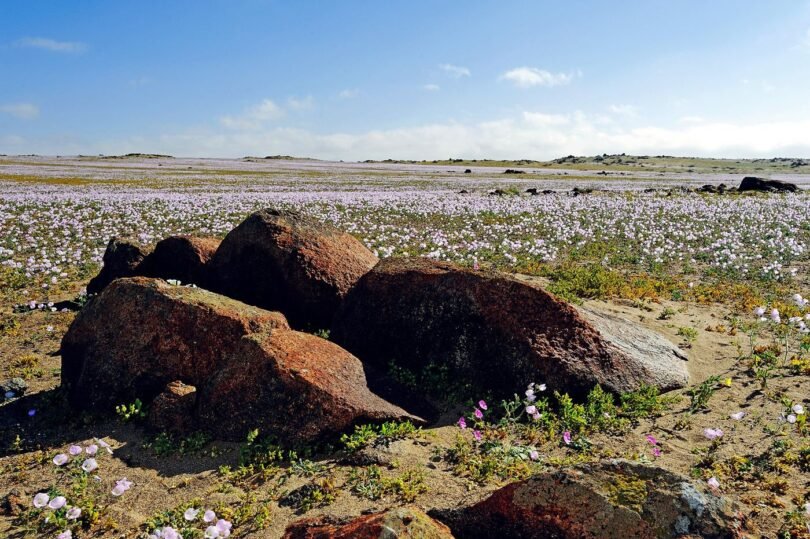

One of the driest places on Earth has burst into flower. NASA’s Earth Observatory published satellite images on 19 November 2026 showing an extraordinary flowering across parts of northern Chile’s Atacama Desert, a phenomenon known locally as desierto florido, or flowering desert. The images, taken by Landsat 8 on 14 September and Landsat 9 in October, show pink and purple blooms spreading across a landscape that is usually bare rock and sand. The flowering happens when enough rain falls to wake seeds that can lie dormant in the desert soil for years, waiting for water. The Atacama is the driest non-polar desert on Earth, and some weather stations there have never recorded rain, which makes a bloom of this scale a rare event. Scientists say the seeds can survive for years in the dry soil, germinating only when the rains finally arrive.
What the Evidence Shows
Desert blooms are more than a spectacle: they are a reminder of how life waits for its moment in extreme places. The seeds of the flowering plants survive for years in dry soil, and when rain finally arrives they germinate quickly, flower, set seed and die within weeks, leaving a new generation of seeds behind. Scientists use satellite images to track these events because they reveal how desert ecosystems respond to rainfall, and how the timing and amount of rain shape what grows. The Atacama bloom also draws visitors and researchers from around the world, though Chile protects the flowering areas to stop people picking the flowers. As rainfall patterns shift with a changing climate, events like this one may become more or less common, and watching them from space is one way to find out. Reporting and analysis from sources such as Nature track the same developments, and specialists following the Atacama Desert bloom say the direction is now consistent across independent lines of evidence.
The Wider Context
The wider context is a research landscape in which replication and open data now decide reputations. Findings connected to the Atacama Desert bloom are being checked by independent groups with shared datasets, and the teams involved publish their methods in full so rivals can test every step. That discipline is slower than a headline cycle, but it is why results in this area increasingly survive first contact with scrutiny.
What Happens Next
What happens next in the story of the Atacama Desert bloom will be decided by follow-up work already under way: larger samples, longer observation and instruments that have not yet come online. The researchers involved are unusually united on one point, that the current results justify the next investment of time and money. Readers will not have to wait long for the first tests of that claim. You can follow related developments in our coverage of science.
None of this will be settled by a single announcement, study or product launch. The pattern to watch is accumulation: independent confirmations, honest reporting of failures and steady improvement in the underlying numbers. Readers who follow those signals, rather than the loudest claim of the week, will understand this subject better than most of the commentary surrounding it suggests is possible.