The first step in dealing with water damage is that there is no time to lose because this problem can become a serious health risk if nothing is done to stop it in its tracks within a very short period of time. From as quick as 24-48 hours, normal moisture intrusion may suddenly develop into a growing toxic mold problem.
For homeowners who have experienced unexpected leaks or flooding, working with a professional water damage restoration in Centennial such as Restoration Logistics Centennial is the most efficient way to deal with the hidden moisture problem.
Image Source: Pinterest
The Critical 48 Hour Window
Mold spores occur naturally in the outdoor and indoor environment. They are inactive until certain conditions are met that will enable them to grow and multiply. The introduction of water into an environment becomes the catalyst for enabling such microorganisms to grow.
Relative Humidity and the Need for Organic Food Sources
For a mold to grow, it needs three major ingredients to form colonies which include oxygen, organic food source and moisture. Some common building materials such as dry wall covered in paper facing, ceiling tiles, carpeting and wood framing act as sources of food in abundance. The presence of humidity exceeding 60% in a building triggers the spores to land in the wet organic materials and start feeding to grow.
How Mold Spores Spread Throughout the House
When mold spores sprout, they produce roots like structures known as hyphae that penetrate through the porous materials of the building. As they develop, millions of microscopic spores are released into the air from the growing colonies. If there is HVAC functioning within the house during the process of moisture intrusion, it distributes spores through its ducts into other parts of the house.
Actions to Undertake Prior to Professional Services
The actions taken right after a water damage incident are very critical in preventing secondary growth of mold. Taking direct action can help contain the moisture.
Locating the Water Source and Ensuring Electrical Safety
In any instance of water damage, locating the source of water is the first thing that needs to be done regardless of whether it involves turning off the main water supply or putting up a roof tarping system. Above all, the safety of the occupants of the property should be guaranteed especially when there is standing water around electrical appliances.
Removing Standing Water and Ventilating the Area
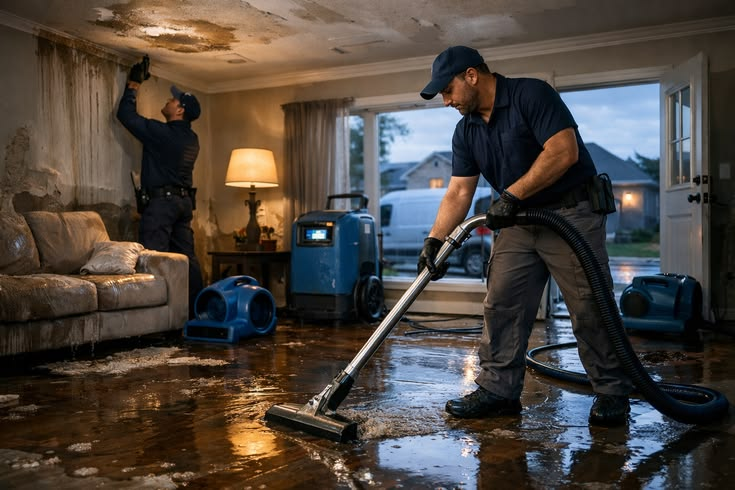
It is necessary to remove the accumulated water in a safe manner by means of wet vacuums or mops to avoid excessive saturation. Window opening may be required for improved ventilation, but only when humidity outside is not high; otherwise, windows need to be closed during the process of utilizing the ACs for facilitating condensation. Standard home fans are not recommended in case mold contamination is anticipated due to the high wind speed generated.
Advanced Methods of Water Removal: Why Basic Solutions Do Not Work?
Basic solutions of surface-level drying cannot be effective enough to avoid the development of toxic molds since water easily seeps into hidden cavities of construction elements.
Industrial Psychrometrics and Monitoring Techniques
Restoration work requires the use of knowledge on psychrometry that is the science related to the study of moist air thermodynamics. Restoration work requires calculation of the flow rate of air, temperature, and specific humidity to facilitate effective evaporation.
Utilization of commercial LGR (Low Grain Refrigerant) dehumidifiers along with high velocity air movers helps in the recovery of moisture from the deep subfloors and wall framing.
Detection of Hidden Moisture Zones
Water is likely to gather in spaces around the baseboards, under the vinyl flooring, as well as in the walls. In circumstances where there is no indication of moisture in the wall itself, it is entirely possible that there is an abundance of moisture within the inner cavity of the wall.
Using the services of water damage restoration in Centennial will ensure the use of non-invasive thermal cameras and moisture meters for moisture mapping.
Dangers of Toxic Black Mold
As there are many kinds of molds that can develop indoors, there are certain types which can pose great health hazards to property dwellers, therefore making moisture control absolutely essential.
Conditions Under Which Toxic Types of Molds Grow
Toxic black mold is a type of mold known as Stachybotrys Chartarum, and requires moisture saturation all the time for growth and normally grows on materials that are organic and contain cellulose like sheetrock and wood paneling. While regular molds do not release any toxins, toxic black molds release mycotoxins which are lethal to humans.
Dangers Linked with Exposure to Mycotoxins
The health risks associated with mold contamination involve prolonged breathing difficulties, continuous sinus congestion, irritation of the throat, fatigue, headaches, and frequent asthma attacks. Professionals use negative air machines and HEPA filtration for containment purposes during restoration.
Navigating Insurance and Documentation for Mold Prevention
Determining the Timeline of Sudden and Accidental Loss
Insurers generally only consider claims for mold damage if it has been caused by a “sudden and accidental” water loss event such as a broken water supply line, which was acted upon quickly by the owner of the property. Any delay may result in the adjusters using the excuse of negligence to deny coverage on any mold damage as a result.
Creating Detailed Logs with Local Experts
To convince insurers that appropriate drying measures have been followed, it is vital to have documentation in place. Having a reliable water damage restoration in Centennial will give you the itemized daily psychrometric drying logs, thermal images, and equipment utilization details. This is very helpful in convincing adjusters that the structure has been well protected.
Conclusion
The prevention of any water damage leading to hazardous mold growth necessitates timely and immediate action within the first 48 hours. Water seeps rapidly into the porous surfaces, thus setting the stage for mold growth that can be detrimental both to building structure and to health. Basic cleaning of the surface area is useful but will not do away with the moisture entirely.